
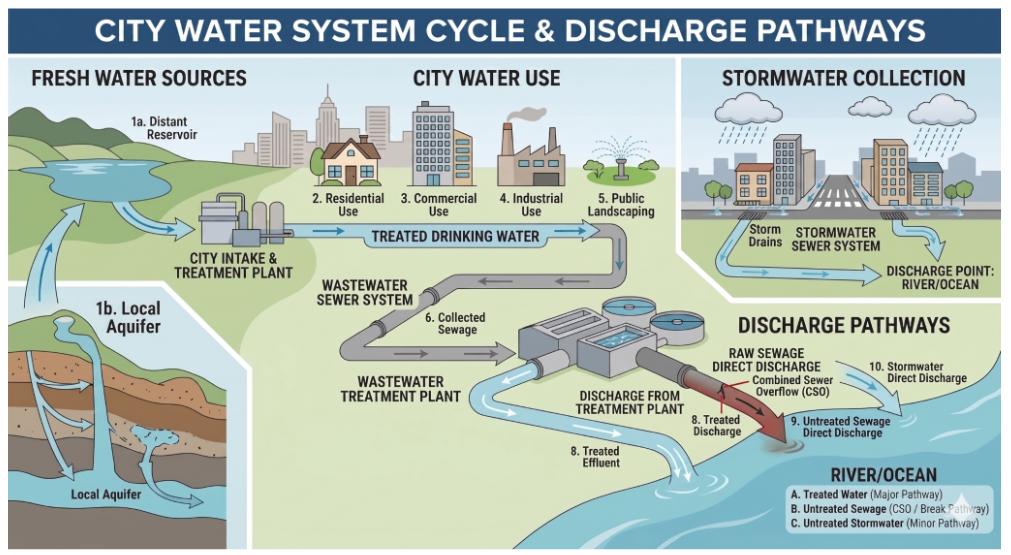
In the mid-1800s, city health officials began linking cholera and typhoid outbreaks to contaminated drinking water. The obvious solution was to create separate utilities for sewage and clean drinking water. While sewage was easily piped to nearby rivers and oceans, it was hard to find a reliable quantity of clean drinking water; so public officials began creating reservoirs upstream and outside of city limits, and drilling deep wells to tap aquifers.
According to the American Society of Civil Engineers (ASCE), there are nearly 150,000 independent public potable water systems, which include thousands of pump houses, treatment facilities, 2 Million miles of water mains, and an additional 100+ million branches which connect the mains to the meters. Approximately 33.3 Trillion gallons of drinking water is lost annually due to ageing infrastructure, resulting in more than $187 Billion in economic losses.
Our nation’s sewer system includes 5.4 million miles of pipe, 17,500 wastewater treatment plants, and 2.5 million stormwater treatment assets. ASCE estimates there are 3.3 annual sewer failures for every 100 miles of pipe; a number that is escalating.
Despite many water system components being between 50 and 150 years old, our water system works, but it can’t keep up with the growth of data centers and advanced manufacturing (which use mass quantities of water), and all the things that come with population growth.
Our nation’s water problems go much deeper. The fundamental design of our water system is the result of 150+ years of accumulated, ad-hoc decisions that don’t make sense in Industry 4.0.
Our water system is the single most fragmented and isolated utility in our country. Each of our 150,000 public potable water systems is independent; they are not interconnected like our electric grid. This means that a city suffering a catastrophic failure of their water system cannot easily be helped by a neighboring jurisdiction.
In addition, some of the smaller water systems are struggling to deal with their ageing assets with a small tax base and large regulatory burden. This is why some states are currently pushing for “regionalization” which would interconnect the failing smaller water systems. But we are far from the “wet” east from helping the west coast with their persistent droughts.
Reservoirs are often too far from the consumer. Before water purification technology existed, it made sense for cities to build dams and create remote reservoirs where fewer humans could pollute them. The vast majority of our nation’s main reservoirs are a great distance from the cities they serve; many are over 100 miles outside city limits. This requires massive infrastructure to bring volumes of clean water into the city; often with the help of pumping stations and treatment facilities. On top of that, cities with this setup are often dealing with dams, water tunnels, and aqueducts between 60 and 150 years old; and the maintenance of these systems is driving cities into substantial debt.
Aquifers collapse when they are overdrawn. Aquifers offer advantages over reservoirs – water is naturally filtered through the soils above, they are pressurized, and they can be tapped in close proximity to the cities and towns that they serve. But if they are overpumped, the aquifer cavity can collapse, permanently reducing underground water storage capacity.
When a collapse occurs, the effects can be seen at-grade, causing the land to sink tens of feet, and fracturing the water distribution infrastructure. Overpumping can also affect surrounding rural wells, which are usually shallower, causing them to run dry. This phenomenon is accelerating throughout the Southern and Western United States.
Our water systems are a one-way ticket to the ocean. Fresh water is a precious and finite resource, yet our water system is essentially one-way flow out to sea. The US Environmental Protection Agency (EPA) estimates that our nation recycles only 7.8% of the water we consume, despite the fact that many of our reservoirs and aquifers are being overdrawn.
Up to the early 1900’s Combined Sewer Systems (CSS) were constructed, predominantly in northeastern cities and around the Great Lakes. These carry a combination of wastewater and stormwater in the same pipe. Up to the present day, when rain causes CSS volume to exceed the treatment plant capacity, they overflow, dumping raw sewage into the river, lake, or ocean. Even with today’s modern regulations, the EPA tolerates 4 to 6 overflow events per year, where significant quantities of raw sewage are released into our rivers, lakes, and oceans.
Modern construction methods now involve separate stormwater and wastewater sewers. But these, too, discharge to streams, rivers, and the ocean; and these twin sewer networks require double the money to build and maintain.
Our water systems and flood resiliency efforts are sometimes working at cross-purposes. Many US cities have faced increased frequency of coastal and/or cloudburst flooding. The response has been multi-billion-dollar megaprojects which will only be used during rare storm events – sea walls, flood gates, and water tunnels to catch excess stormwater and wastewater. Ironically, these cities are building costly resiliency projects to keep water out, while simultaneously maintaining costly and byzantine systems to bring in water from 100+ miles away for citizens; all in an era where the technology exists to purify local water.
The urgency to develop Water Infrastructure 2.0
While our water system works, inefficiency and vulnerability will become more evident as humanity ventures deeper into Industry 4.0. Demand for water utilities is ever-increasing, and our businesses and citizens deserve affordable, reliable, and safe water. Our water systems are over $300 Billion in debt; the consumer cost of water and sewer services is outpacing CPI by up to 4.8x in some jurisdictions; and the ASCE estimates that the water/wastewater State of Good Repair (SGR) backlog will exceed $2 Trillion by 2043.
This begs the question of whether a $2 Trillion dollar investment in the current water system makes sense; or if it’s time to reinvent the water system from a blank canvas. Such a reinvention would comprise an interconnected water grid with enough water recycling to eliminate dependency on distant reservoirs and mitigate the risk of overdrawing aquifers.
The engineering solution can begin in a single or multiple concurrent local jurisdictions, which can be interconnected over time. This allows for initial proof-of-concept and long-term scalability.
Status of solution:
- Enabling policy concept
- Engineering concept and implementation roadmap